 Activities & Play
 Behaviour
 Childcare
 Children's rights
 Development & Growing Up
 Family, Friends & Relationships
 Feeding Your Baby
 Food & Eating
 Health & Safety
 Mental Health & Wellbeing
 Money & Work
 Online Behaviour & Safety
 Pregnancy & First Days
 School & Education
 Sleep
Sleep


Jump to a section in this article
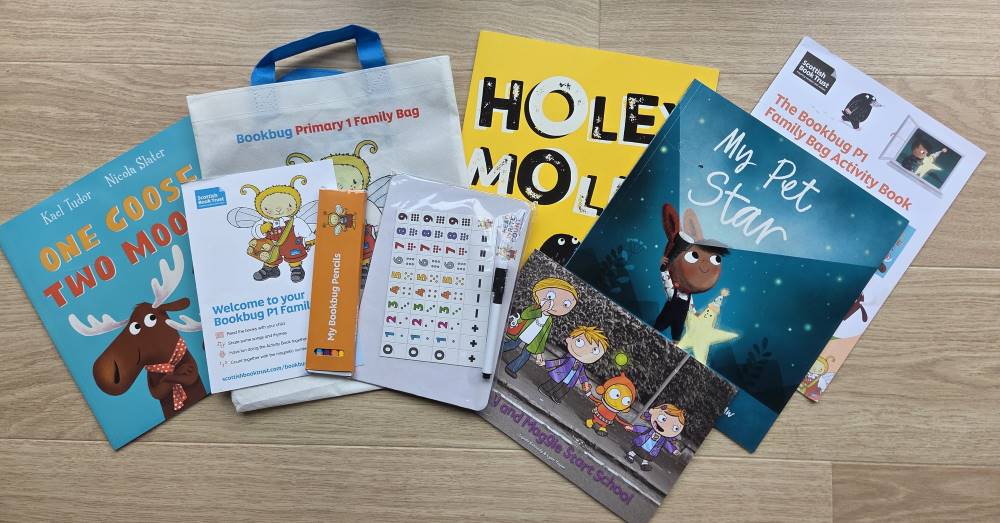
All Primary 1 children receive a free Bookbug P1 Family Bag during the autumn/winter term. The bag is packed full of exciting items for you and your child to have fun playing with together. It's also a great resource to turn homework into little games you can play together.
What's in the bag?
Take a peek inside, and you will find:
- My Pet Star by Corrinne Averiss and Rosalind Beardshaw
- Holey Moley by Bethan Clarke and Anders Frang
- One Goose Two Moose by Kael Tudor and Nicola Slater
- A whiteboard and whiteboard pen and a set of magnetic numbers
- Colouring pencils
- Ziggy and Maggie Start School by Lynda Kennedy and Lynn Taylor
There’s also an activity book full of fun things to do together all relating to the books in the bag, and if you finish all those we’ve got some ideas here too.
Whiteboard games
Game #1: Secret messages
Ask your little one to write you a secret message on their whiteboard, then hide it somewhere for you to find. When you find it you can write a message back, hide the board again and then ask them to find it and see if they can read your message. You can also both draw pictures to make your message easier to understand.
Their whiteboard can also be a fun way to get them to do their spelling homework.
Game #2: Guess the word
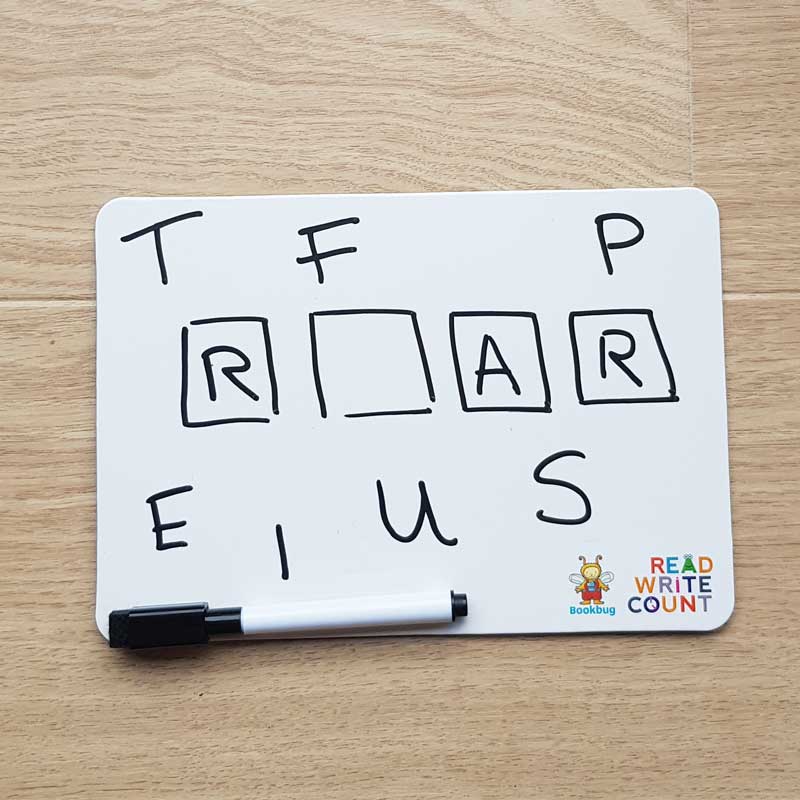
Think of a word and draw boxes on the board for each of the letters. Ask your child to guess letters that could be in the word. If they get a correct letter, write it in the box where it belongs. If the letter isn’t in the word, write it somewhere else on the board. If they can guess the word you’ve chosen before the board is full, they’ve won!
Game #3: Half and half
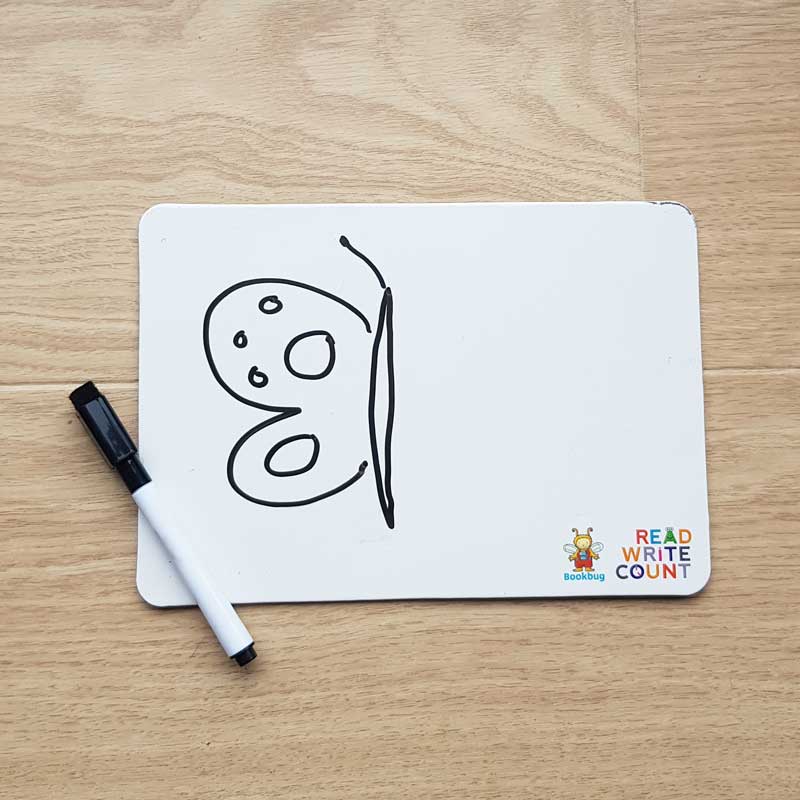
To help your child learn about shapes and symmetry, use the whiteboard to draw half of a picture (e.g. the outline of a butterfly, a ladybird, an octopus or a house) and get them to draw the other side. Swap roles so they draw the first half of the picture and you have to finish the drawing.
You can find more tips for making maths fun here and on the Maths Week Scotland website.
Game #4: Fun with numbers
Give them mini-challenges each day with their number magnets to keep them entertained, like counting backwards from 10 to zero, or a doing a couple of sums like 3 + 4. How fast can they do it? Can they write the biggest number they know? Can they say it out loud?
You can find more tips for making maths fun here and on the Maths Week Scotland website.
My Pet Star by Corrinne Averiss and Rosalind Beardshaw
When a little girl discovers a star who has fallen to earth, she takes him home and nurses him back to health. This sweet story of friendship is perfect for any child who’s ever longed for a pet of their own.
You and your child can watch a video of Corinne Averiss reading My Pet Star on the Scottish Book Trust website.
Game #1: Friends forever
The wee girl in the book makes friends with her pet star and shares her toys with him. There are lots of games you can play with your child to help them learn to share. One of our favourites is Teddy Bear’s Picnic.
Encourage your child to collect up their teddies or other toys and some small items they can share between them (this could be anything – socks, stickers, scraps of paper, other little toys). Then ask them to set the teddies out in a circle and share the items between them. This will help them think about sharing and fairness, two important skills when it comes to making friends. You can watch a Teddy Bear’s picnic video on the Cbeebies Parenting website here and find more ways to help your child make friends here.
Game #2: Twinkle twinkle little star
Sharing a book and singing is a great way to help your child settle down for bed. After reading My Pet Star, how about singing ‘Twinkle twinkle little star’ together? You can find it in the Bookbug Song and Rhyme Library here.
You can find more top tips for bedtime here.
Game #3: My star pet
If your child could have anything for a pet what would it be? A star, like the one in the story? A dog or cat? Or maybe something bigger, like… a dinosaur! Ask your child to draw a picture of their fantasy pet and colour it in with their Bookbug pencils. What does it eat? What does it like to do? Could they take it for a walk to the park?
Holey Moley by Bethan Clarke and Anders Frang
Can Gus the goat guess where Mavis the mole lives? Here’s a clue: it’s definitely NOT a hole! This hole-arious guessing game book is fun for all the family.
You and your child can watch a video of Bethan Clarke reading Holy Moley on the Scottish Book Trust website.
Game #1: Holey moley bowly
In the book Gus the goat loves coming up with rhymes. You could try finding rhymes as you go about your day – for example, on the walk to school can your child find things to rhyme with bus, road, park, car and so on? Does anything rhyme with their name? Thinking up rhymes is a great way to practise their phonics.
Game #2: Holy moley guacamole
Guacamole is another word Gus finds to rhyme with moley. If your child’s not tried guacamole we have an easy recipe to make some here – it’s a great way to get more veggies into them! If they’re a picky eater, you might be able to tickle their tastebuds with other recipes that link to stories – like the three bears’ porridge or Mr Wolf’s pancakes.
You can find more tips for tempting fussy eaters here.
Game #3: Guessing games
Guessing games are great for learning to take turns. A fun guessing game to play while you’re on the go is ‘Who am I?’ One of you pretends to be a character from a favourite book or show (like Gus or Mavis) and the other player has to ask questions to try and guess who you are (“Are you an animal?” “Do you live underground?”). But you can only answer yes or no. (Just don’t be surprised when your child picks somebody you’ve never heard of and extends the game for ages!)
One Goose Two Moose by Kael Tudor and Nicola Slater
Everyone has to line up for ice cream. But wait – some animals are in the wrong line! Can Simon the goose sort them out? This laugh-out-loud book helps make counting fun.
You and your child can watch a video of Kael Tudor reading One Moose Two Goose on the Scottish Book Trust website.
Game #1: Two geese, three moose
The plural of goose (when there’s more than one) is geese – but the plural of moose is… moose! Can your child think of any other words that have unexpected plurals? (Clue, try mouse, sheep, deer, person, child.)
Game #2: There's a moose loose
There are so many moose in this story! Can your child count how many different moose there are in the whole book? They’re all wearing different outfits too – which is your child’s favourite? You could ask your child to draw an outfit for a moose (or a goose) inspired by the pictures in the book.
Game #3: Feeling the feels
Simon the goose gets very frustrated when the animals refuse to get in the right line! What makes your child frustrated? This could be a good opportunity to talk about different emotions and how we show them. Can they find a moose that looks happy? Or annoyed? Or shocked? You could try drawing some faces together with different expressions, like emojis.
Our page on talking to your child about mental health has more tips for helping them talk about how they’re feeling.
Ziggy and Maggie Start School
Alien Ziggy is on a mission to help everyone stay safe. Go Safe with Ziggy books and activities help equip children with the skills, knowledge and attitudes that will help keep them stay safe now and in later life. Children can follow Ziggy’s adventures here and you can find out more about staying safe when you’re out and about here.
More resources
You can find loads of fun resources for using the Bookbug P1 Bag with your wee one on the Scottish Book Trust website.
Accessible versions of the P1 Bookbug books
CALL Scotland have produced accessible versions of the P1 Bookbug books as well as symbol resource sheets that can be found on the Scottish Book Trust website. The symbol resources can be used with pupils who need additional support and those with communication difficulties, as well as children with English as an additional language (EAL).


 Childcare
 School & Education