 Activities & Play
 Behaviour
 Childcare
 Children's rights
 Development & Growing Up
 Family, Friends & Relationships
 Feeding Your Baby
 Food & Eating
 Health & Safety
 Mental Health & Wellbeing
 Money & Work
 Online Behaviour & Safety
 Pregnancy & First Days
 School & Education
 Sleep
Sleep


Jump to a section in this article

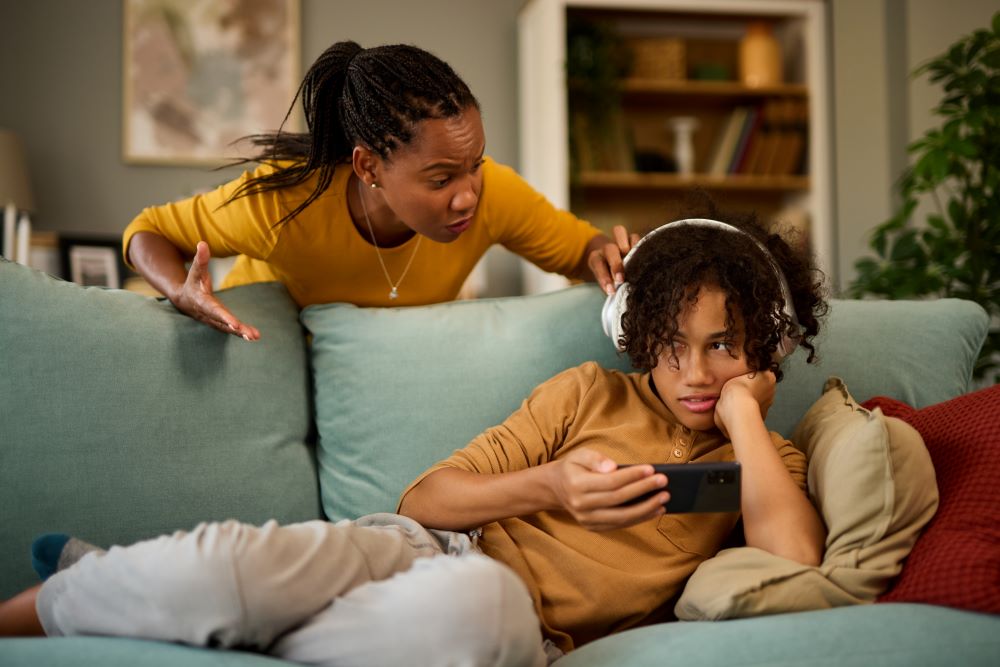
We’ve all been there. We ask them to put away the phone, tablet or games console and they chuck a massive strop and tell us they hate us. But if screens are causing arguments in your family, help is at hand. Here we explain why screens and devices have such a hold on our kids, and what we can do to help prevent or deal with tech tantrums.
Why do children get so attached to their devices?
When children get more chances to chat, play and express themselves, they often find it easier to share their feelings with words instead of tantrums. Our page on chatting with your child explain how noticing and responding to your child’s signals helps them feel heard and understood.
If you ask your child to stop playing with their Lego and come and have their dinner they might grumble a bit but they’ll probably come to the table quite quickly. But ask them to put their phone or tablet away and it could provoke a much more stroppy, even angry, reaction. Here are some reasons why:
- Children can get really immersed in what they’re doing online, and being asked to stop can come as a shock. Think about how absorbed you can be in an Instagram or TikTok scroll, for example, and how the rest of the world can fade away – it’s the same for kids.
- Playing video games or watching entertaining content is fun. It releases a ‘feelgood’ chemical called dopamine into our brains. Dopamine makes us feel good, but when we get a dopamine ‘hit’ we want another one, so we want to repeat the activity that released it. Which is why kids want to play a game again and again or watch ‘one more video… and another… and another…’
- Social media and online games are designed to keep us scrolling or playing. When we’ve finished watching one video on YouTube or TikTok, another one pops up straightaway. When we’ve finished one level in a game, we can immediately move to the next. Every time we click, we’re giving our brains that dopamine hit, which is why it’s so hard to stop.
- Getting immersed in an online world can help children set aside worries or frustrations instead of dealing with them. When they stop, the worries or frustrations return.
Tips for preventing tech tantrums
Tip #1: Set boundaries
You might want to think about setting rules around when your kids can and can’t use their devices. Applying these rules consistently can really help reduce arguments around screen time.
For example, you could decide to:
- ban phones and devices during mealtimes
- switch off devices at least an hour before bedtime and keep them out of bedrooms at night
- agree times when your child can use their device and stick to these times.
These pages can help with this:
- Our page on screen use for toddlers explains how it’s important to limit time on devices for very young children.
- Our page on setting boundaries for using mobiles and other devices has tips for setting rules for younger children.
- Our page on rules and consequences for teens looks at how working with young people to set rules will make it more likely they’ll follow them.
You can also download a family internet usage agreement from the Internet Matters website.
Tip #2: Use built-in screen time tools
Many devices and social media and gaming platforms have tools that you can use to set time limits. You can find out more about different screen time tools on the Internet Matters website.
Tip #3: Explain why
Children are more likely to follow rules if they understand why they’re in place. “Cuz I said so” doesn’t always cut it! So you could try explaining to them why it’s important to have a healthy balance of activities in their life, like spending offline time with family and friends, keeping active and sleeping.
You could compare it to eating a healthy diet – even little kids know they can’t eat chocolate all day, however much they might want to.
Tip #4: Give them a countdown
If your child is glued to their screen, stopping the activity immediately is more likely to provoke a tantrum than unsticking them gradually. So set a time limit (for example, “you can play your game for 30 mins” or “you can watch 1 episode of your show”) and then remind them when the time is nearly up. You could use a physical reminder like an egg timer to show them how long they have left.
Tip #5: Provide fun alternatives to screen time
Online games and videos aren’t the only thing that can give your kids a dopamine ‘hit’. Other fun activities like listening to music they love, playing with favourite toys, dancing, playing sport or drawing can all take the place of screen time and will probably leave your child feeling much more relaxed and happy.
So while you may find it hard to get them to off their screen to do something boring like cleaning their room or doing their homework, following tech time with a fun, non-screen-based activity like dancing round the living room or colouring could help them move from one activity to another.
Our 25 screen-free activities offer alternatives for younger children, while teens could have a look at our teen activity pages.
Tip #6: Put devices away when you're not using them
Ever heard the saying “Out of sight, out of mind?” Simply hiding away phones and tablets when the kids aren’t using them can help them avoid temptation and focus on other activities.
Tip #7: Be a good role model
You’re the biggest influence on your child as they grow up, so it’s important to set a good example to them when it comes to screen use – hard as that can be. Our page on reducing your screen time has some tips to help.
Tip #8: Help them work through worries
Some children (and adults) use screen time to distract themselves from their worries. This can make it even harder to stop scrolling, gaming or watching, as returning to the ‘real world’ means returning to our worries.
This is why it’s important we help our kids work through their worries rather than distracting them. Our page on helping kids deal with worries has tips to help younger children, and our page on helping teens with anxiety has tips for helping older children.
Tips for dealing with tantrums
Sometimes tantrums and outbursts happen anyway, no matter how hard we try to avoid them! Here are some tips for riding them out.
Tip #1: Try to stay calm
Easier said than done we know, but if you get angry with your child or start lecturing them, it’ll only make things worse. So take a few deep breaths, count to 5 and maybe step out of the room for a few minutes before you react. Our pages on coping with being a parent and coping with raising a teen have more tips to help.
Tip #2: Don't try to reason with them
If your child is really upset or angry, they won’t be in the right place to listen to you, no matter how reasonable you’re being. So instead you could say something like “I see you’re really upset right now so I’m going to give you some time to calm down and we’ll talk about this later.”
Tip #3: Talk to them afterwards
Once they’ve calmed down, you can talk to them about why this behaviour isn’t acceptable. It’s important to let them know that it’s not them that’s the problem, it’s their behaviour. You could also focus on how their behaviour makes you feel. So instead of saying things like “You’re being rude,” or “You’re being naughty,” you can say something like, “It upsets me when you’re angry like this.”
Try and discuss things calmly. This is where having boundaries and rules in place can help. For example, if they say something like “You never let me play on the Playstation,” you can point out all the times they are allowed to use it.
Tip #4: Set consequences and stick to them
Setting consequences for difficult behaviour can be tricky and varies from family to family. You may decide to stop them using their screens for a certain amount of time if the devices are causing problems in your household. However, try not to isolate your child from their friends in doing this. Maybe put the devices away for a while, but not for a whole weekend, for example.
Tip #5: Always make up afterwards
Once your child has calmed down, it’s really important to hug and make up. This sets a really good example for your child, no matter how old they are.
Help and support
Dealing with bad behaviour can be exhausting. If you’re feeling overwhelmed, it’s a good idea to talk to someone you trust, like a partner, friend, family member or your GP. You can also chat in confidence to Children First's support line.




 Family, Friends & Relationships
 Mental Health & Wellbeing